On 30 June 2026, the operational processing for Sentinel-3's ocean-colour products changed. The new baseline carries updated vicarious calibration gains for both OLCI instruments, and it is being used to reprocess the full mission archive. The larger rework landed in February, when the Collection-4 baseline rebuilt the chlorophyll algorithm and the calibration itself; June tightened the gains on top of it. This piece is about the June update, because the small correction shows the machinery more clearly than the big one.
Let's unpack that slowly, because the implication is larger than it looks.
OLCI is the Ocean and Land Colour Instrument, the optical imager on the two Sentinel-3 satellites. For ocean work it produces, among other things, chlorophyll-a concentration and remote sensing reflectance, the colour signal that actually escapes the sea surface. These are the raw material of marine ecology, fisheries, water-quality monitoring, and a good deal of climate science. The operational record runs back to the first products in 2016.
System Vicarious Calibration is the discipline at the centre of this. A satellite radiometer does not measure chlorophyll. It measures radiance at the top of the atmosphere, in a set of narrow spectral bands. Everything downstream, including the chlorophyll number a fisheries agency eventually reads, is the output of a processing chain: atmospheric correction to strip out the air, then bio-optical algorithms to turn the remaining water signal into a geophysical quantity. Small errors anywhere in that chain propagate to the final product.
Vicarious calibration tunes the sensor's gain factors so that the geophysical products it derives line up with high-quality in-situ measurements taken at the surface: dedicated ocean optical reference sites where instruments in the water measure the same quantity the satellite is trying to infer. You adjust the gains until the satellite's answer matches the reference. The reference is the ruler. The gains encode how the sensor is read against it.
So when an agency updates those gains mid-mission, it is making a specific, quantified statement: the previous gains were slightly off. Not catastrophically, not visibly, but measurably. And because the gains sit near the front of the processing chain, a change to them moves every product derived through that chain. Which is why a gain update is never a forward-only switch. It forces a reprocessing of the entire back catalogue, so that data measured last week and data measured in 2017 sit on the same scale.
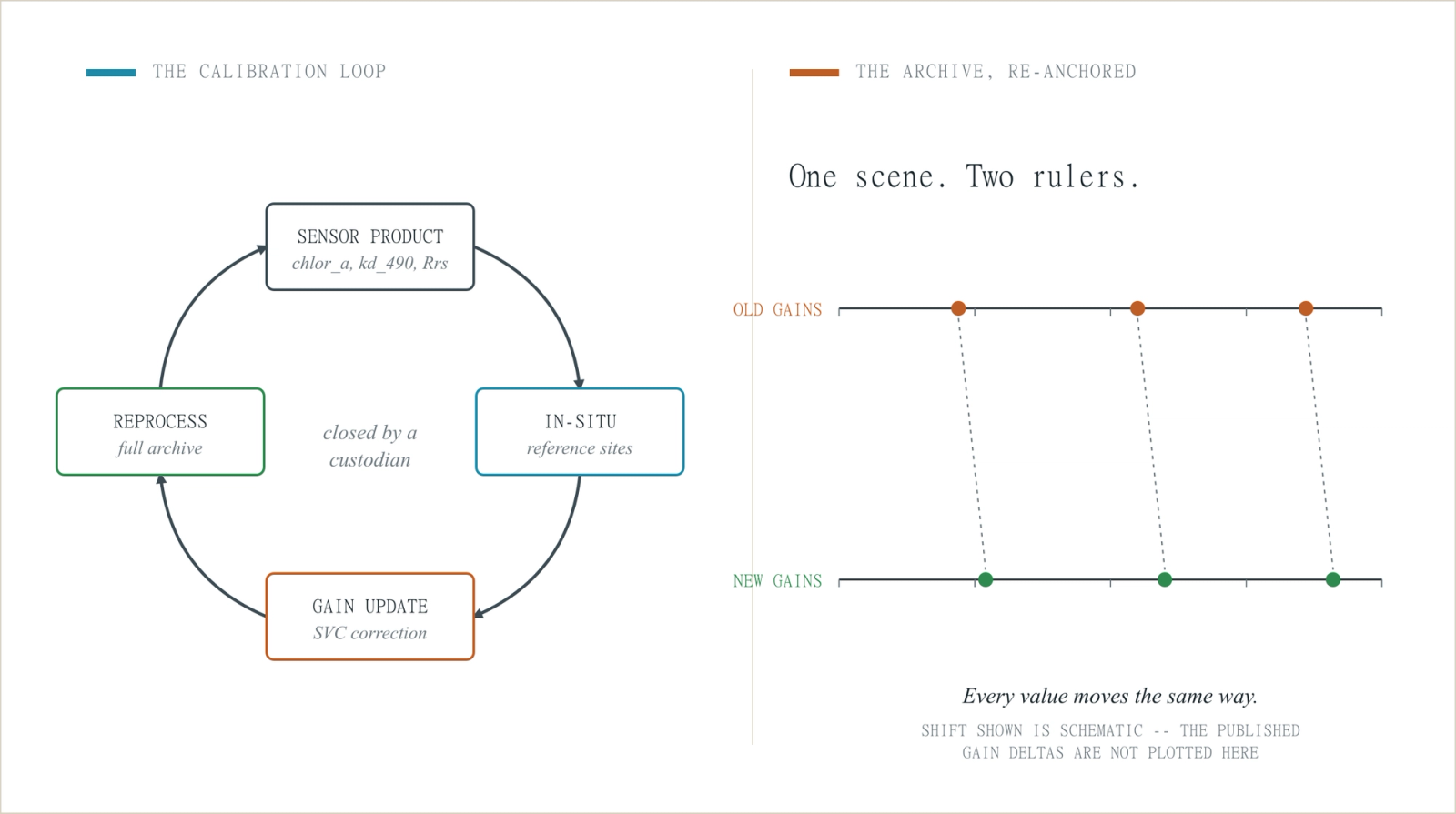
Figure 1 is the whole argument in one picture. The left panel is the loop that makes this possible. The sensor produces a value; the value is compared against the in-situ reference; the gains are corrected to close the gap; the archive is reprocessed onto the corrected scale; and the cycle repeats as the references accumulate and the sensor ages. The right panel is the consequence. Run the loop, change the gains, and the same patch of ocean now reads a slightly different number than it did before. Old baseline and new baseline are two rulers laid against the same water. What the right panel does not show is a magnitude. EUMETSAT has not published the per-band gain deltas as a single headline figure, so we have not invented one. The point is the relationship, not a number we cannot source.
Now the part worth sitting with.
Every chlorophyll value, every reflectance spectrum produced on the old baseline carried a small systematic bias. Not random noise that averages out across a region or a season, but a consistent offset in a consistent direction, the kind that survives averaging and quietly tilts a trend. That bias was real the entire time. It was simply invisible, because nothing had yet measured it. It became visible only at the moment the agency quantified it, by changing the ruler.
Anyone who published a trend on the old baseline, or made an operational decision on it, did so on numbers that have now moved. A long-term chlorophyll decline computed last year is not necessarily the same decline today. The water did not change. The scale under it did.
It is worth being concrete about how a front-of-chain offset behaves, because the intuition that it will wash out is wrong. Picture a kitchen scale that reads three percent light. The number is invented; the behaviour is not. Weigh one apple and the error is a rounding nuisance. Weigh ten thousand apples across a year, then compute the trend in apple mass, and the three percent does not average away, because it is not noise. It is in the same direction every single time. The systematic part is exactly the part that contaminates the long-baseline conclusions that matter most: decadal trends, cross-year comparisons, the slow signals that climate work is built on. A bias you can characterise, you can remove. The danger is the one you have not characterised yet, sitting in the record looking exactly like signal.
The only reason this bias has a number attached to it at all is that ESA and EUMETSAT operate continuous vicarious calibration as designed-in infrastructure: people, reference sites, processing baselines, and a standing commitment to reprocess the entire archive every time the calibration improves. That should raise your confidence in Sentinel-3, not lower it. It is what a custodian of the measurement looks like. The loop in Figure 1 is closed because someone is paid, and mandated, to close it.
There is a perverse incentive hiding here, and it is worth naming: Doing this in the open carries a reputational cost that doing nothing does not. A published correction can always be recast as an admission that the earlier numbers were wrong, the same rhetorical move that greets a revised climate projection with "so they were exaggerating all along." The logic is inverted. The revision is not the failure; it is the evidence of diligence. The failure would be the silent archive that never gets corrected because no one wanted to absorb the optics of changing it. An organisation that reprocesses a decade of its own data in public is doing the expensive, honest thing, and the structure around it should reward that, not tax it.
That discipline is rare, and it is expensive. Reference sites have to be maintained for years. The reprocessing of a decade of global data is a serious computational and organisational undertaking, repeated each time the calibration is refined. Most of the Earth-observation market has no equivalent. A great many commercial optical platforms, including constellations whose data feeds into emissions estimates, agricultural analytics, and environmental compliance, have nothing resembling a standing vicarious-calibration programme tied to maintained in-situ references and full-archive reprocessing.
The structural point follows directly. Those sensors carry the same kind of drift. Detector responses age, optics degrade, atmospheric-correction assumptions slip. The physics does not exempt a commercial sensor from the problem that EUMETSAT just corrected on Sentinel-3. What the commercial sensor usually lacks is the loop. There is no custodian comparing its products against references, no mechanism quantifying its bias, no archive-wide correction when the bias is found. So the error stays exactly where Sentinel-3's used to be: silent, in the same direction, indistinguishable from real signal, waiting for a decision to depend on it.
This is the calibration-custody problem in one clean example. Across the contractual handoffs of a typical EO data supply chain, from instrument builder to platform operator to data reseller to analytics vendor to the customer reading a number, no single party owns the uncertainty of the final measurement end to end. Sentinel-3 is the exception that makes the rule legible, because here the custody is explicit and you can watch it work. The 30 June update is what custody looks like when someone is actually exercising it.
So the right response to this reprocessing is not alarm. If you rely on Sentinel-3 ocean-colour data, the practical action is mundane: as the reprocessed archive rolls out, re-derive anything that depends on absolute values or long-baseline trends, and treat results computed across the baseline boundary as not directly comparable until reprocessed. That is housekeeping, and the agency has given you everything you need to do it.
The harder question is the one this event should leave you holding. For every dataset you use that does not come with a recalibration like this, ask who is closing the loop. Ask where the in-situ references are, how often the gains are checked, and what happens to the archive when they change. If the answer is that nobody is doing this, the absence of a correction is not evidence the data is fine. It is evidence that no one has looked. A recalibration you never see is not the reassuring case. It is the one to worry about.
Defensible practice, in the end, is not heroic. It is not a clever one-off correction applied in a crisis. It is the boring, standing, designed-in version of what EUMETSAT did here: a reference you trust, a loop that runs whether or not anyone is watching, and a commitment to move the whole record when the ruler moves. That infrastructure is what separates a measurement you can build a decision on from a number that merely looks like one.